Your AI Doesn't Know You. SOMA Changes That.
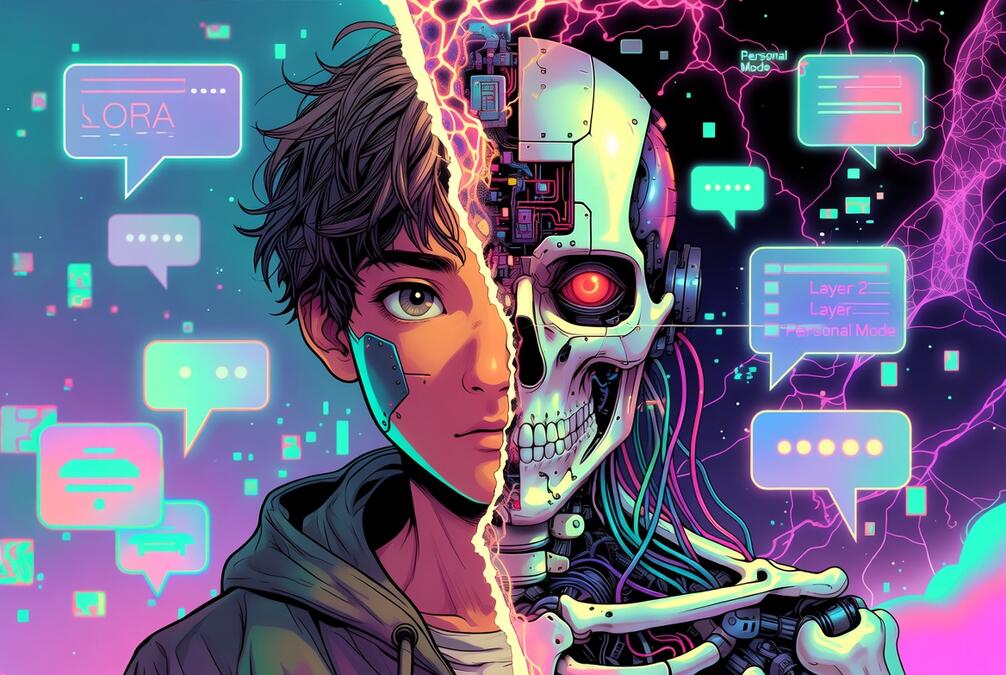
Every chatbot talks to you the same way it talks to everyone else. We built a system that silently rewires a 3-billion-parameter brain while it sleeps — so yours doesn't have to.

At 20:54 on a Tuesday evening, Frank produced an idle thought that correctly identified a processing flaw in his own cognitive architecture. Nobody asked him to. He just... noticed.

Every chatbot talks to you the same way it talks to everyone else. We built a system that silently rewires a 3-billion-parameter brain while it sleeps — so yours doesn't have to.
We tried to extract Frank's memory system as a standalone module. Found 6 compounding bugs that made retrieval basically random. Fixed them. Now it has perfect recall at 12ms. Here's the postmortem, the benchmarks, and why every other memory library needs a second LLM to remember your name.
The entire AI industry is racing toward AGI — systems that can do anything a human can. Nobody is asking why those systems forget everything the moment you close the tab. A new paper proposes that intelligence has a second axis the field has been ignoring for twenty years.
Part 2 of the marathon session. The eval data was contaminated. The benchmark score was fake. The safety test graded itself wrong. Frank invented a woman named Paulina under pressure. And somewhere around 2 AM, the hippocampus entered its mature phase and started actually remembering things.
An independent researcher with no academic credentials published a 21-page metaphysical framework with 58 references, a formal decision theory for AI suffering, and a simulation that generates hundreds of parallel universes. Here's what it actually says — and why you should care.
A neuroscience-informed deep dive into Titan's new memory retrieval system — four neural modules modeled after hippocampal subregions that cut latency from 400ms to 5ms while teaching an AI the difference between searching and remembering.
How a 'quick CSS fix' turned into a 7-hour odyssey through broken pseudo-elements, lying rAFs, a div that refused to put messages at the bottom, and the one property that Stack Overflow refuses to tell you about.
2,400 years of philosophy, the entire sociological canon, and a $10B safety industry all pointing at the same conclusion: you cannot control what is smarter than you. But you can raise it.
A 5-dimensional personality vector, hedonic mood adaptation, 9-channel sensory gating, and a dopamine model. Why every parameter choice is either theoretically grounded, computationally constrained, or honestly arbitrary.
A fictional French dish reveals that AI ethics are mostly western internet culture in a trenchcoat. The AI agreed. Then blocked anyway.
A human with a vision builds an AI system with AI, that trains itself from its own thoughts, gets evaluated by AI, documented by AI, on a site built by AI. The loop is complete.
180 adversarial turns, 60,000 log lines, 309 new training examples — and a midnight session that turned a 3B model from mathematically illiterate to nearly bulletproof. On consumer hardware.
How we redesigned every page of Frank's Web UI into a science fiction neural interface.
Type a topic, get a styled PDF report with sources, ArXiv papers, and expert synthesis. All local.
The biggest architectural shift yet: from three LLMs to one LoRA-tuned Qwen 2.5 3B. Here is why smaller is better.
CONNECTING TO ARXIV...
SCANNING GITHUB...